Wing Chun Maxim
Body
Sometimes the best way to go forward is to go back
Sometimes the best way to go forward is to go back
The theory of Wing Chun has no limit in its applications.
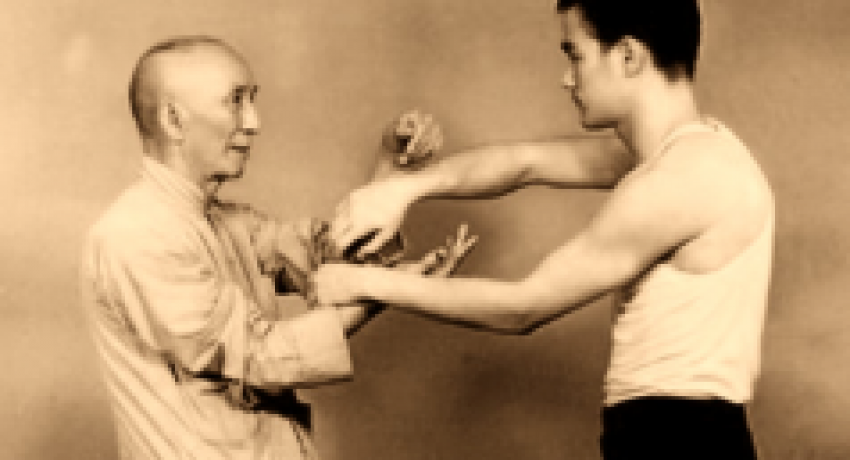
Chi sao is a training exercise which develops structure, reflexes, balance, positioning and management of your body-mass and the concept of 'sticking' to your opponent.
The concept and value of 'sticking' to the opponent is fundamental to Wing Chun - basically it means not pulling away or losing contact with on opponent once you've got it.
Wing chun doesn't move back and forth trading blows like sport fighting, once the fight has started you try to 'stick' to the opponent, drive forward and attack continuously the last thing you want to do is to give them time to think or recover, especially if they are bigger or stronger than you!
Chi sao is not the same as sparring, it is a training drill intended to develop your sensitivity and reflexes so when you come into contact (bridge) with an opponents arm (or leg in chi gerk) you instinctively react and control your opponent to give yourself the greatest advantage.
Chi Sao is not a competition but an interactive way to help one another develop structure, sensitivity and reflexes. Chi Sao training is intended to help you realise your weaknesses and strengths and build on them. It can also be played as a game which can be a lot of fun and is addictive as hell! (you were warned..)
We start with single sticking hand practice (Dan chi sao), which focuses on developing proper hand techniques for attacking and defending along the centre-line. It also isolates each arm to ensure both are trained equally and counteract the normal arm 'favouritism'.
Double sticking hands (Seung Chi Sao) develops coordination between the arms predominantly for intercepting attacks (bridging), trapping your opponents hands and striking at the same time. Chi sao can also be used to develop grounding and management of your mass to deliver force, basically it becomes a whole body exercise.
For more information check out our other articles
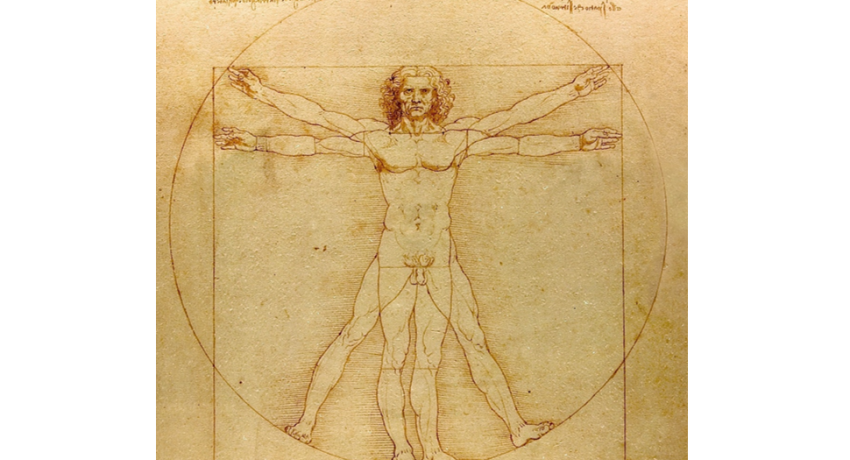
The is the true centre of the body: the nexus point which connects the top and bottom halves of the body and is situated between the pelvis and lower abdomen. The precise location varies slightly from person to person but is generally at the centre-line point just below the navel (belly-button). In Chinese martial arts and medicine it is considered as the lower ‘dantian’ or swadhisthana chakra in yoga.
The centre of mass is critical to body movement and balance: Awareness of your centre of mass and learning how to manage it is essential to develop the ability to deal with incoming force as well as the outward projection of force without compromising your balance.
The relationship between the centre-line and centre of mass determines body structure or biomechanics which is the most essential component of any martial art but especially in Wing Chun because of the specific way the system manages and delivers force.
See other articles for more info...

Engaging and opponent, specifically making contact with an opponent, is referred to as bridging.
Once a 'bridge' or contact with the opponent’s body is made, usually and arm or leg, the goal is to achieve one or more of the following effects:
The main aim of wing chun practice is to enable the practitioner to achieve all of these effects instinctively and rapidly as soon as a bridge is made. If achieved, it guarantees maximum effect from the engagement and minimises opportunity for counter attack or evasion.
Regardless of the outcome of each separate engagement, the attack must be continuous and relentless; constantly seeking to bridge and impact into the opponent until the opponent is no longer a threat or the way is clear to leave.
In principal you should not retreat but continually move forward to close the distance with the opponent to enable bridging, 'sticking' and attack of the opponents centre. In practice however it is often expedient to take a measured step back but only in order to achieve a better way forward. In such circumstances the backward step is rarely in a straight line as little advantage is gained from doing so. In these circumstances the 'circling' or side stepping is often most expedient as these provide opportunity to close the range, 'bridge' and change the angle of incoming and outgoing force all at the same time.
The idea of keeping distance, striking and retreating is not the wing chun way: wing chun is a defensive fighting style not a sport where points count and judges must see all the strikes. Fighting engagements are not meant to last more than a few seconds, the attacks must be continuous and relentless to not allow the opponent time to recover or to reassess the situation and change their tactics accordingly.
Once the bridge has been made and the attack is in progress short steps and pivoting can be used to change the angle of attack, gain additional distance for striking and/or to destabilise the opponent through twisting of the torso and pivoting of the feet. To use these techniques in application the stance must be solid and well 'grounded' but also sensitive and agile; this is developed in proper practice and understanding of the forms.
For more information check out our other articles

As the primary means of attack or defence is most commonly the arms, Wing Chun system requires the shoulders to be square-on to the opponent so both arms are equidistant and the centre of mass can be equally applied behind each arm, this creates a triangle or wedge.
The shortest and therefore fastest distance of travel between two points is a straight line. A straight line therefore represents economy of motion. This is the line Wing Chun uses to either deliver, intercept or manage an incoming force.
Like when you use an an axe to split wood: the force is delivered and deflected along the sides of the axe head (or wedge) and is concentrated toward the leading edge. When the axe-head strikes the wood all of its mass is concentrated behind the smallest area and when it is accelerated it will penetrate and split even a big block of wood with ease.
To make this work in Wing Chun, both of your arms and your leading leg need to maintain proper structure. Your hand or foot must project along the centre line (leading edge of the axe-head) whilst keeping the elbows within the width of the shoulders - the emphasis of the first and most important section of Siu nim tao.
In attack: force is generated and directed from the centre of mass, along the centreline, out of the arm/leg and into the centre-line or core of an opponent; driving the 'wedge' forward.
In defence: an incoming force is intercepted and channelled away from your centre of mass along the outside of your body 'wedge' structure while maintaining a line of attack into the opponent’s centre-line. To avoid using strength-against-strength, forward motion toward the opponents’ centre-line is required to ‘drive the wedge’ and divert the incoming force.
For more information check out our other articles

Grounding refers to the ability to subtly manage ones centre of mass in response to incoming and outgoing force through your whole body structure - channelling it down to, and up from, the ground.
'Grounding' is not the same as having a strong stance although developing the supporting muscles from static stances is required to enable it.
The grounding effect can feel to an opponent like you suddenly become immovable or impossibly heavy but in reality their force is being channelled straight to the ground and being resisted by the compressive resistance of your body which has been developed ever since you learned to walk upright as a child but requires you to have good posture in later life (which is not always easy to maintain!). This can only be developed through static stance training and dedicated practice with an opponent, a dummy or a wall bag, the latter works for hand strikes only.
In Siu nim tao the main stance is 'yee jee kim jeung ma' a higher type of 'horse stance' used by other Chinese martial art styles but with the knees and feet turned slightly inward. This stance represents the neutral or nexus stance from which all footwork develops and flows. Essentially while performing Siu nim tao you are training two 'back legs' for the biu ma front stance or juen ma (turning/pivoting stance). Practicing this stance strengthens the legs, trains proper angle of feet, knees and hips, supports the vertical alignment of the spine and allows development of proper triangulation and projection of force with the arms along the centre-line. This must be trained in a static position before moving or the proper grounding, triangulation and centre-line control will not be developed.
For more information check out our other articles
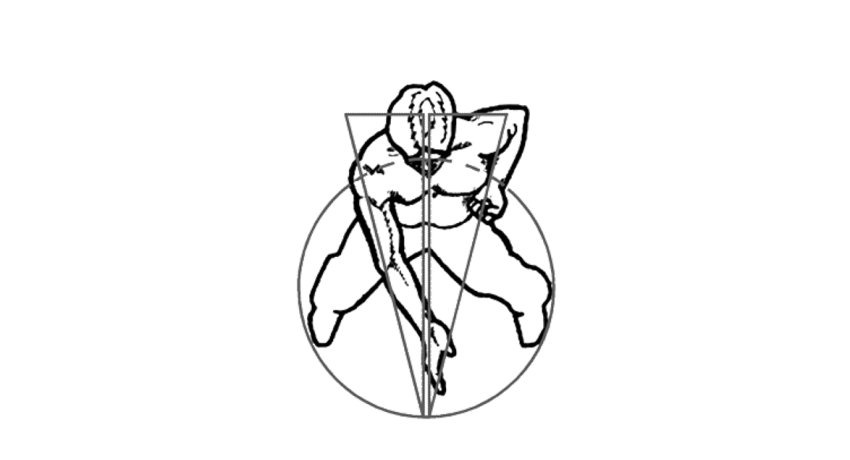
In short, the centre-line is the line you defend in yourself and the line you attack in your opponent. On this line are all the vital points: eyes, nose, mouth, throat, genitalia etc.
This can be considered an imaginary column which runs vertically through the body, forms the basis of body structure and around which all vital organs are arranged.
In Wing Chun all attacks are directed into this centre-line as they are likely to have the maximum impact on your opponent’s health, body structure and balance.
The centre-line runs from the top of your head through your body and out through the middle of your pelvis. When standing with feet parallel the ‘pole’ would project through the pelvis and down to the ground between your legs. When standing with one leg back in a ‘fighting (biu ma) stance’ the pole would project out through the pelvis, down the back leg and out through the heel of the foot.
The centre-line is not exactly the same as the spine but is naturally greatly linked. However, when facing an opponent square-on it is useful to use the spine as the centre-line reference point.
For more information check out our other articles
Wing chun has a several unarmed 'forms' which are intended for practice on your own.
The first and most important is called Siu Nim Tao which translates as the 'way of the little idea'.
Wing chun forms (called patterns or kata in other styles) are not routines based on fight simulations but are instead sets of developmental exercises which concentrate on simple movements which can be applied in multiple situations and train the body and mind to work in synchronicity, they provide a toolkit which can be used in any number of different ways.
Wing chun is a concept driven style but one focused on basic human biomechanics rather than mimicking aspects of other animals for example. Skill is developed through practice of forms and through contact drills with opponents.
Some of the most important concepts include:
If you want to go into any of these in more depth, check out our other articles